

Recently, QIAO Yu, a young faculty member from the School of Mathematics and Statistics at SDUT, in collaboration with YAN Yong’s research group of National Center for Nanoscience and Technology, made new progress in neuromorphic intelligent gustatory sensor. The simulated artificial gustatory system can identify correctly the four basic tastes: sour, bitter, salty, sweet, and complex flavors like coffee and cola. The relevant achievement about the research was published in PNAS,one of the top international journals, with the title of “Confinement of ions within graphene oxide membranes enables neuromorphic artificial gustation”. Nature also made a special report on it, titled “Sweet or sour? AI-powered device achieves human-like sense of taste”.
Bio-inspired neuromorphic computing is one of the core research directions in artificial intelligence, and an integrated system for sensing, storing and computing that simulates human senses is the most important research topic in this field. Compared with the currently widely studied visual and tactile perception, the integrated sensing-storage-computing system simulating human senses will play a unique role in fields such as environmental monitoring, food safety, health monitoring, disease diagnosis and taste reconstruction. Different from visual and tactile perception, taste perception not merely involves chemical (biological) substance exchanges, the operation of devices also requires an aqueous physiological environment, giving rise to far more complex interfacial reactions and mass-transport dynamics. Consequently, integrating sensing, memory and computing into a single gustatory in-sensory unit remains exceptionally challenging.
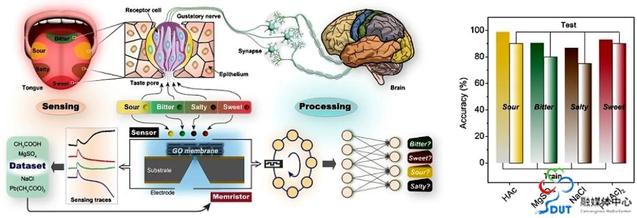
graphene-oxide-based smart gustatory system
To address these challenges, based on stacked graphene-oxide films, researchers have developed a new nanoionics device integrating sensing and computation, which could operate directly in aqueous phase. Ion-dynamics characterization and finite-element simulations reveal that interfacial adsorption-desorption within the graphene-oxide sheets dramatically retards ion mobility, endowing the device with both ion-sensing and memristive characteristics. Exploiting the sensing capability, the team has built a library of chemical signatures for a broad range of flavors, while the device’s neuromorphic properties are used to implement a reservoir-computing network that mimics an artificial gustatory system. Working in physiological conditions, the single chip delivers simultaneous sensing and computation, laying the groundwork for integrated sensing-storage-computing system for smart gustatory applications in liquid settings and offering new hope for patients who have lost their sense of taste.
QIAO Yu, together with Dr. ZHANG Yuchun and Dr. candidate LIU Lin from the National Center for Nanoscience and Technology are the co-first authors of the paper; Principal Investigator YAN Yong is the corresponding author. The research receives funds from the National Natural Science Fund Project of China, the Shandong Provincial Natural Science Fund Project, and other projects.
Founded in 1914, Proceedings of the National Academy of Sciences of the United States of America (PNAS) is a world-renowned leading multidisciplinary science journal published by the U.S. National Academy of Sciences. Recognized as an authoritative source of original research findings, PNAS covers multiple fields including the bioscience, physical science, and social science. Its high academic quality had made it one of the most cited and influential multidisciplinary science journals worldwide. It is recognized internationally as one of the top four comprehensive journals along with Nature, Science and Cell. PNAS has ranked among the TOP comprehensive journals in the first zone of the Chinese Academy of Sciences Journal Classification, with a five-year impact factor of 10.6.