

On November 14th, after a 204-day journey in space, 48 precious planarian samples safely returned alongside the Shenzhou-20 astronaut crew. This marks the success of China’s first space-based planarian regeneration experiment led by SDUT.
In April, with the successful launch of the Shenzhou-20 manned spacecraft, the planarians carefully-selected by the research team led by Professor CAO Zhonghong from the School of Life and Medicine Sciences in SDUT were sent to the China Space Station for the first time. The experiment aims to systematically analyze the effects and underlying mechanisms of space microgravity and radiation environments on planarian regeneration.
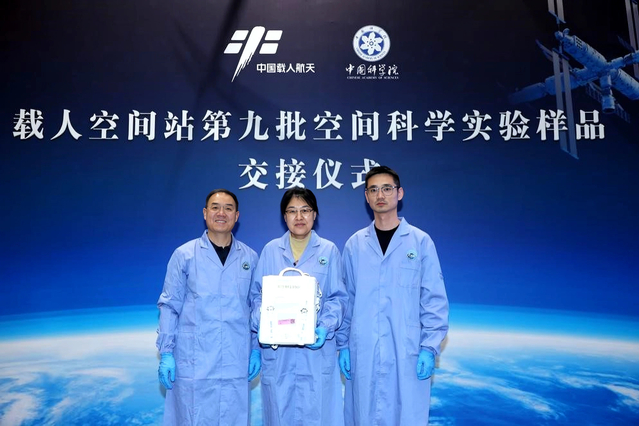
“The recovered planarian sample bag weighs 219.8 grams. The labeling is correct, with no damage, thawing, or leakage.” The moment when the specimens were successfully placed into the laboratory freezer, Cao Zhonghong’s long-held anxiety finally eased.
Planarians, living fossils in the biological world with a history exceeding 520 million years, are among the Earth’s oldest bilaterally symmetrical animals and demonstrate remarkable regenerative capabilities. Since the 18th century, planarians have served as an ideal model for life regeneration research. Several international space experiments have ever been conducted previously, but the data obtained remained relatively limited due to constraints in experimental design.
SDUT’s research team has been continuously conducting scientific research on planarians for over 20 years. Based upon innovative experimental procedures, this space experiment adopted a dynamic “three-time-point, three-sample-size” research strategy. The 48 planarian tissue segments were loaded into a self-developed microfluidic chip, enabling real-time imaging of the regeneration process aboard the space station, along with sample fixation and preservation at different time points. This approach has significantly enhanced the systematic and scientific value of the collected data.
During the experiment, astronauts aboard the Wentian lab module completed the planned operations including sample observation, collection, and low-temperature storage. Through seamless coordination between the space crew and ground teams, all procedures were executed with precision, ultimately ensuring the safe return of the planarian samples to the laboratory.
“This space-based planarian regeneration experiment has, for the first time, captured image data of planarian regeneration in space and achieved the preservation of samples at different regeneration time points,” stated CAO Zhonghong with confidence. “Next, we will conduct molecular detection and analysis on these ‘space planarians’ to study the impact of the composite space environment on their regenerative repair capabilities. This will enable us to identify potential molecular targets applicable to human tissue repair and injury mitigation.”